• German
  • English
sales@pica-berlin.de
+49 30 255 66 00-0

PiCA - Prüfinstitut Chemische Analytik

MENUMENU
  • Home
  • Company
    • Company

      • About PiCA
      • News
      • Career
      • Accreditation
  • Services
    • Services

      • Product analysis
        • Consumer goods
        • Plastics
        • Migration
        • Toys
        • Food and feed
        • Textiles
        • Cosmetic products
      • Indoor analysis
        • House dust investigation
        • Air quality investigations
        • Wood preservatives
        • Material analysis
      • Environmental analysis
        • Soil
        • Water
        • Air
        • Waste
      • Pesticide analysis
      • Special analytics
      • Research
      • Expert reports
      • Conformity assessment
  • Index of substances
    • Index of substances

      • Search by name or CAS number
  • Contact
| Home | News | high speed method for the determination of more than 700 pesticides in fat and oils

high speed method for the determination of more than 700 pesticides in fat and oils

16. November 2017

The conventional method of determining pesticides in fats and oils (§64 LFGB-Method Collection) L00.00-34) uses a complicated procedure to separate the pesticide molecules from the fat molecules. It is known as GPC (Gel Permeation Chromatography).  After that, the large volume of solvent is reduced in a vacuum to less than one milliliter.  This method was developed in the 1980s and is still in use today in residue laboratories.
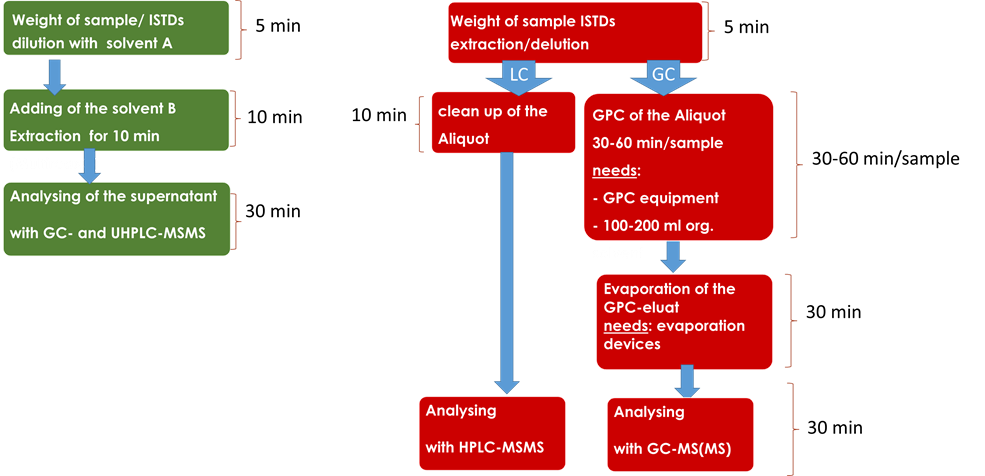
PICA Method                                                      Conventional Method


The time needed for the measurements that follow in the latest measurement system UHPLC-MSMS and GC-MSMS can also be reduced by optimizing the measurement parameters.


With this procedure we can offer an express screening analysis for pesticides in fats and oils (same day, one day, two days).


Our procedure is validated for an oil mixed matrix made up of raw soy bean, olive, sunflower seed and sesame oils. The quality and correctness of the method have been 100% confirmed in annual FAPAS ring tests since it was developed in 2015 (see  table). The method has has also been successfully tested with fish oils and other animal fats such as milk fat.


ring test/ compound

rape seed oil-FAPAS_05107_09/10-2015

palm oil-FAPAS_04/06-2016

Aldrin

√

gamma-HCH (Lindan)

√

Nirofen

√

PCB 153

√

p,p´-DDE

√

Cypermethrin

√

Endosulfan-alpha

√

Ethylparathion

√

Lambda-Cyhalothrine

√

p,p´-DDT

√

Erfolgsquote (%)

100

100

This procedure has been accredited at PICA since 2017 (DakkS).


Please contact us. We would be glad to inform you.

Contact: Dr. Anna Romanotto (anna.romanotto@pica-berlin.de) or Tel.: +4930 255660062

News

  • Trace Analysis of Bisphenol A in Canned Food by DI-SPME-ARROW-GC-MS/MS

  • Formation of sulforaphane during lactic acid fermentation of nasturtium (Tropaeolum majus L.)

  • What do 3-MCPD and 2-chloroethanol have in common?

  • Attention: Expiry date for beers made from hops containing bifenazate or etoxazole

  • Analysis of benzene in propellant gases

  • Fast and reliable analysis of ethylene oxide (incl. 2-chloroethanol) in food

  • Important information for our customers – Our laboratory remains open

  • Identification of nicotine sources in indian tea

  • Target screening of acrylates from UV-curing inks and coatings in food contact material

  • Sample preparation for multi-residue analysis in difficult matrices with an optimized push-through-SPE

Index of substances

Search by name or CAS number

Accreditation

Accreditation according to DIN EN ISO/IEC 17025:2018

Legal Information

  • Imprint
  • Data protection
  • General Terms and Conditions

Sample Drop-off Hours

Monday – Friday: 8:00 AM – 4:30 PM
Express Service: Drop-off by 12:00 PM at the latest

Contact

PiCA
Prüfinstitut Chemische Analytik GmbH
Rudower Chaussee 29
12489 Berlin - Germany

Tel.: +49 30 255 66 00-0
Fax: +49 30 255 66 00-1

E-Mail: mail@pica-berlin.de